News
Advancing FAIR and Collaborative Computational Modelling: A New Upload Added to the GATE
A recent peer-reviewed article, “Ten simple rules for good model sharing practices” (1), makes an important contribution to Open Science by addressing how computational models can be shared, understood, and reused more effectively across disciplines. The work strongly aligns with the Open Science guiding thoughts of collaboration and FAIR data, and illustrates how methodological innovation can foster trustworthy research and long-term scientific progress.
Collaboration as a Foundation for Model Innovation
The article highlights collaboration as a central prerequisite for advancing computational modelling. By breaking down disciplinary and technical silos, the authors demonstrate how shared conceptual frameworks and community-driven standards enable more robust and transparent model development. This collaborative approach reflects a key guiding thought of Open Science: innovation thrives when researchers co-create, critique, and refine models together rather than in isolation.
In line with the GATE’s mission, this contribution shows how shared understanding and collective reflection help transform models from opaque artefacts into communicable scientific knowledge. Such practices are essential for building a research culture that values openness, reproducibility, and shared responsibility—principles the GATE actively promotes across the research ecosystem.
Extending FAIR Principles to Computational Models
A second major contribution of the article lies in its engagement with FAIR principles—Findability, Accessibility, Interoperability, and Reusability—and their application to computational models. While FAIR has traditionally focused on data and software, the authors emphasise that models introduce additional challenges due to their integration of conceptual assumptions, metadata, and executable components.
By addressing these challenges, the article advances an important Open Science discussion: how to make models not only technically reusable, but also readable and actionable for diverse audiences. This resonates strongly with the GATE’s understanding that FAIRness is not an end in itself, but a means to enable meaningful knowledge exchange, reuse, and capacity building.
Connecting Research Practice and Open Science Capacity Building
The article exemplifies how methodological research can directly support Open Science education and training. Its insights are highly relevant to researchers, educators, and infrastructure providers who aim to teach or apply transparent, reusable modelling practices. This is precisely where the GATE positions itself as an intersection: connecting cutting-edge research contributions with Open Science training, guiding thoughts, and sustainable dissemination pathways.
Open Science in Practice
This contribution demonstrates how collaboration and FAIR principles can be operationalised in complex research contexts such as computational biology. It reinforces the GATE’s conviction that Open Science is not an abstract ideal, but a set of practices that—when thoughtfully implemented—strengthen research quality, transparency, and societal impact.
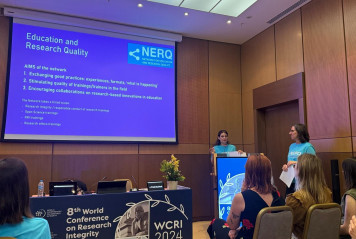
Have a look at the last GATE Workshop.
(1) Kherroubi Garcia I, Erdmann C, Gesing S, Barton M, Cadwallader L, Hengeveld G, et al. (2025) Ten simple rules for good model-sharing practices. PLoS Comput Biol 21(1): e1012702. https://doi.org/10.1371/journal.pcbi.1012702